
02 模型结构代码解读
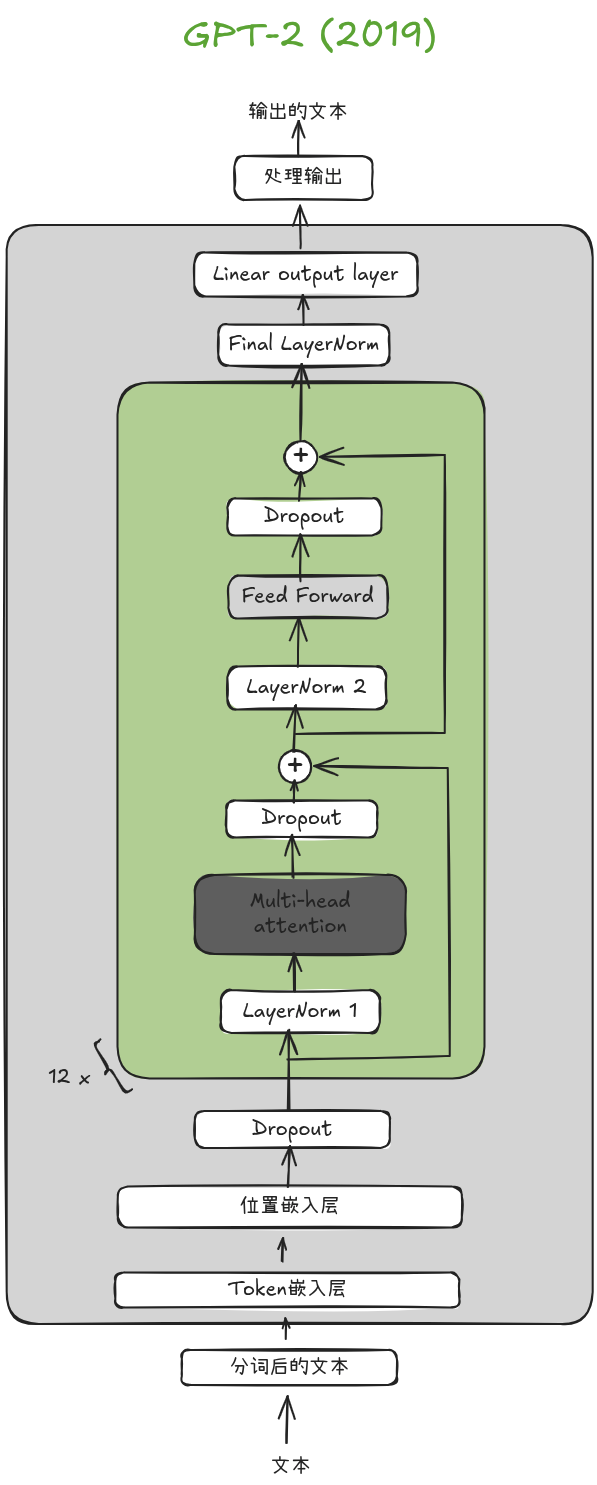
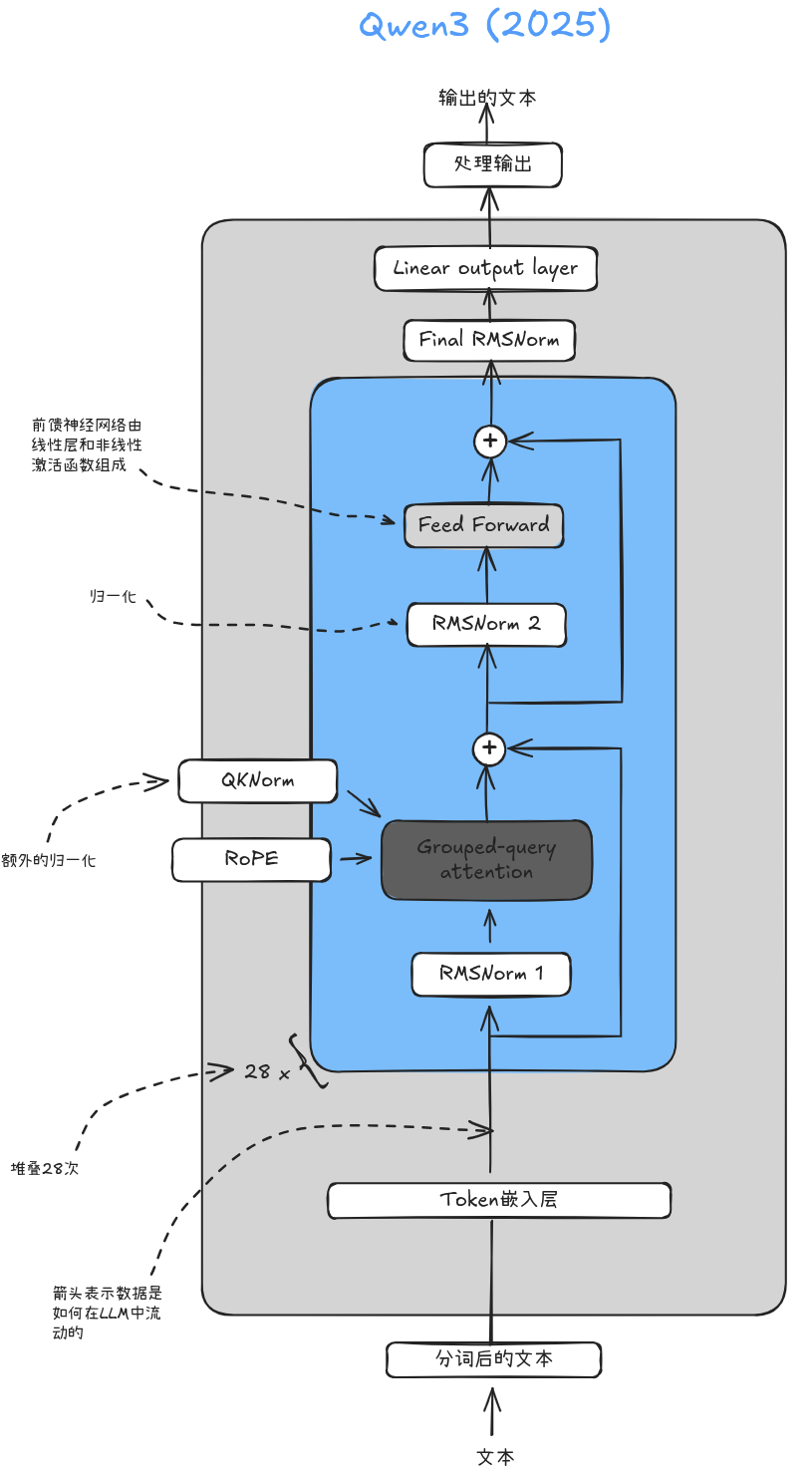
学习理念:通过手写 GPT2 和 Qwen3 的完整代码,理解 Transformer 组件在真实模型中的组装方式。GPT2 是经典 Decoder-only(MHA + 可学习位置编码),Qwen3 是现代 LLM 代表(GQA + RoPE + RMSNorm + SwiGLU)。两相对比就能看清架构演进。
海外对标:GPT2(OpenAI 2019)、Qwen3(阿里 2025)
本节 AI 替代率:~75% | 人工干预率:~25%
| 角色 | 能力范围 |
|---|---|
| 🤖 AI 擅长 | 生成模型代码骨架、解释前向传播维度变化 |
| 👤 人类需理解 | KV Cache 的 prefill/decode 两阶段逻辑、GQA 中 K/V 的 repeat_interleave 机制 |
📌 来源说明:以下代码来自
3.代码/fine_tune_proj/00_gpt2_model_structure.py和01_qwen3_model_structure.py,提取核心部分,省略测试代码。
📖 阅读优先级
| 等级 | 章节 | 说明 |
|---|---|---|
| 🟢 直接跳过 | 全部 | HuggingFace 一行 from_pretrained 就能用,除非你要改模型结构 |
一、GPT2:经典 Decoder-only
1.1 整体结构
python
class GPTModel(nn.Module):
    def __init__(self, cfg):
        super().__init__()
        # 输入层:token embedding + 可学习位置 embedding
        self.tok_emb = nn.Embedding(cfg["vocab_size"], cfg["emb_dim"])
        self.pos_emb = nn.Embedding(cfg["context_length"], cfg["emb_dim"])
        self.drop_emb = nn.Dropout(cfg["drop_rate"])

        # Transformer Block 堆叠
        self.trf_blocks = nn.ModuleList(
            [TransformerBlock(cfg) for _ in range(cfg["n_layers"])]
        )
        self.final_norm = LayerNorm(cfg["emb_dim"])
        # 输出层:投影到词表
        self.out_head = nn.Linear(cfg["emb_dim"], cfg["vocab_size"], bias=False)

        self.current_pos = 0  # KV Cache 位置追踪

    def forward(self, in_idx, use_cache=False):
        tok_embeds = self.tok_emb(in_idx)
        # 位置编码:use_cache 时用累加位置,否则从 0 开始
        if use_cache:
            pos_ids = torch.arange(self.current_pos, self.current_pos + seq_len)
            self.current_pos += seq_len
        else:
            pos_ids = torch.arange(0, seq_len)
        pos_embeds = self.pos_emb(pos_ids).unsqueeze(0)
        x = tok_embeds + pos_embeds

        for blk in self.trf_blocks:
            x = blk(x, use_cache=use_cache)
        x = self.final_norm(x)
        logits = self.out_head(x)
return logits🔥 【P0 必须理解】
use_cache控制是 Prefill(全量计算)还是 Decode(增量计算)。self.current_pos追踪当前已缓存的 token 数量。
1.2 MultiHeadAttention + KV Cache
🔥 【P0 必须理解】 这是整个代码中最核心的部分。KV Cache 的三段逻辑:
cache_k is None→ Prefill 阶段,直接存入cache_k exists→ Decode 阶段,torch.cat拼接新 K/V 到缓存- mask 切片:从
ptr_current_pos开始,只对当前要计算的 token 做 mask
python
class MultiHeadAttention(nn.Module):
    def __init__(self, d_in, d_out, context_length, num_heads):
        self.W_query = nn.Linear(d_in, d_out)
        self.W_key = nn.Linear(d_in, d_out)
        self.W_value = nn.Linear(d_in, d_out)
        self.out_proj = nn.Linear(d_out, d_out)

        # 因果 mask(上三角),持久化在显存中
        self.register_buffer("mask",
            torch.triu(torch.ones(context_length, context_length), diagonal=1),
            persistent=False)
        # KV Cache 缓冲区
        self.register_buffer("cache_k", None, persistent=False)
        self.register_buffer("cache_v", None, persistent=False)
        self.ptr_current_pos = 0

    def forward(self, x, use_cache=False):
        batch_size, num_tokens, d_in = x.shape
        # 1. 生成 Q, K, V
        keys_new = self.W_key(x).view(batch_size, num_tokens, self.num_heads, self.head_dim)
        values_new = self.W_value(x).view(batch_size, num_tokens, self.num_heads, self.head_dim)
        queries = self.W_query(x).view(batch_size, num_tokens, self.num_heads, self.head_dim)

        # 2. KV Cache 管理
        if use_cache:
            if self.cache_k is None:  # Prefill:全量缓存
                self.cache_k, self.cache_v = keys_new, values_new
            else:                      # Decode:拼接新 token
                self.cache_k = torch.cat([self.cache_k, keys_new], dim=1)
                self.cache_v = torch.cat([self.cache_v, values_new], dim=1)
            keys, values = self.cache_k, self.cache_v
        else:
            keys, values = keys_new, values_new

        # 3. 注意力计算(含因果 mask)
        keys = keys.transpose(1, 2)      # (b, n_heads, n_kv, head_dim)
        queries = queries.transpose(1, 2)
        values = values.transpose(1, 2)

        attn_scores = queries @ keys.transpose(2, 3)

        # mask 切片:use_cache 时从 ptr_current_pos 开始
        if use_cache:
            mask_bool = self.mask.bool()[
                self.ptr_current_pos:self.ptr_current_pos + num_tokens_Q, :num_tokens_K]
            self.ptr_current_pos += num_tokens_Q
        else:
            mask_bool = self.mask.bool()[:num_tokens_Q, :num_tokens_K]

        attn_scores.masked_fill_(mask_bool, -torch.inf)
        attn_weights = torch.softmax(attn_scores / keys.shape[-1]**0.5, dim=-1)
        context_vec = (attn_weights @ values).transpose(1, 2).contiguous()
        context_vec = context_vec.view(batch_size, num_tokens, self.d_out)
return self.out_proj(context_vec)1.3 生成函数(Prefill + Decode 两阶段)
python
def generate_text_simple_cached(model, idx, max_new_tokens, use_cache=True):
    model.eval()
    with torch.no_grad():
        if use_cache:
            model.reset_kv_cache()                     # 清空旧缓存
            logits = model(idx, use_cache=True)         # Prefill:全量计算 prompt
            for _ in range(max_new_tokens):
                next_idx = logits[:, -1].argmax(dim=-1, keepdim=True)
                idx = torch.cat([idx, next_idx], dim=1)
                logits = model(next_idx, use_cache=True)  # Decode:只输入一个 token
        else:
            for _ in range(max_new_tokens):
                logits = model(idx, use_cache=False)    # 每次全量计算
                next_idx = logits[:, -1].argmax(dim=-1, keepdim=True)
                idx = torch.cat([idx, next_idx], dim=1)
return idx二、Qwen3:现代 LLM 代表
2.1 Qwen3 配置
python
QWEN_CONFIG_06_B = {
    "vocab_size": 151936,     # 词表大小
    "context_length": 40960,  # 训练上下文长度
    "emb_dim": 1024,          # 嵌入维度
    "n_heads": 16,            # 注意力头数
    "n_layers": 28,           # 层数
    "hidden_dim": 3072,       # FFN 中间维度
    "head_dim": 128,          # GQA 头维度
    "qk_norm": True,          # 是否对 Q/K 额外归一化
    "n_kv_groups": 8,         # GQA 的 KV 组数(每组 2 个头)
    "rope_base": 1_000_000.0, # RoPE 的 theta 基数
    "dtype": torch.bfloat16,
}GPT2 vs Qwen3 关键差异:
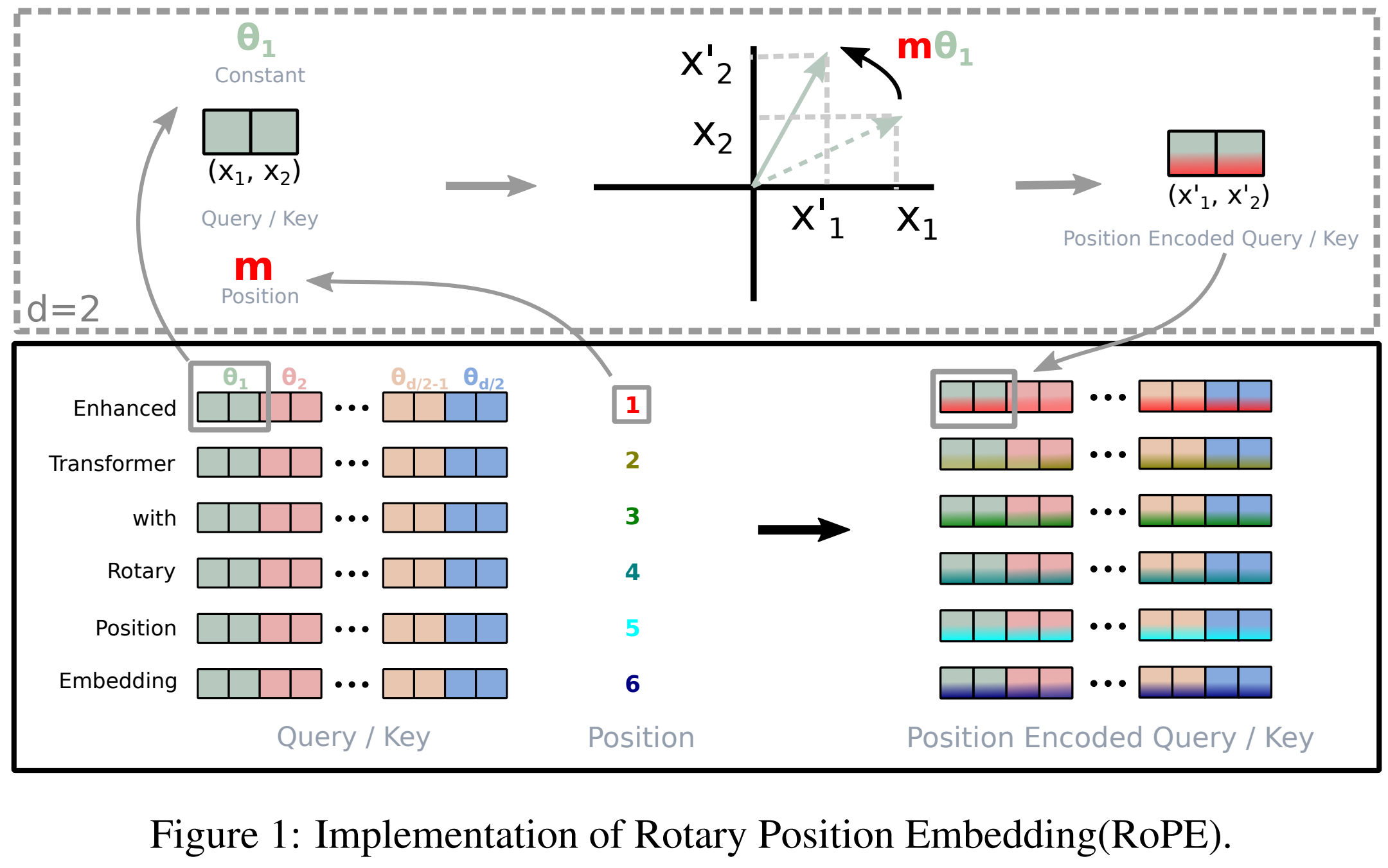
- 位置编码:可学习 → RoPE
- 注意力:MHA → GQA(16 头 / 8 KV 组)
- FFN:GELU → SwiGLU(门控双分支)
- 归一化:LayerNorm → RMSNorm
- 额外:Qwen3 新增 QK Norm
2.2 Qwen3 整体结构
python
class Qwen3Model(nn.Module):
    def __init__(self, cfg):
        self.tok_emb = nn.Embedding(cfg["vocab_size"], cfg["emb_dim"], dtype=cfg["dtype"])
        self.trf_blocks = nn.ModuleList([TransformerBlock(cfg) for _ in range(cfg["n_layers"])])
        self.final_norm = RMSNorm(cfg["emb_dim"])
        self.out_head = nn.Linear(cfg["emb_dim"], cfg["vocab_size"], bias=False, dtype=cfg["dtype"])

        # 预计算 RoPE 参数
        head_dim = cfg["head_dim"] or (cfg["emb_dim"] // cfg["n_heads"])
        cos, sin = compute_rope_params(head_dim, theta_base=cfg["rope_base"],
                                       context_length=cfg["context_length"])
        self.register_buffer("cos", cos, persistent=False)
        self.register_buffer("sin", sin, persistent=False)
self.current_pos = 02.3 TransformerBlock(Qwen3)
python
class TransformerBlock(nn.Module):
    def __init__(self, cfg):
        self.att = GroupedQueryAttention(d_in=cfg["emb_dim"], num_heads=cfg["n_heads"],
            head_dim=cfg["head_dim"], num_kv_groups=cfg["n_kv_groups"],
            qk_norm=cfg["qk_norm"], dtype=cfg["dtype"])
        self.ff = FeedForward(cfg)           # SwiGLU
        self.norm1 = RMSNorm(cfg["emb_dim"])
        self.norm2 = RMSNorm(cfg["emb_dim"])

    def forward(self, x, mask, cos, sin, start_pos=0, cache=None):
        shortcut = x
        x = self.norm1(x)                                           # PreNorm
        x, next_cache = self.att(x, mask, cos, sin, start_pos, cache)
        x = x + shortcut

        shortcut = x
        x = self.norm2(x)
        x = self.ff(x)
        x = x + shortcut
return x, next_cache2.4 GQA 实现
🔥 【P0 必须理解】 GQA 的核心就是 K/V 的输出维度为
num_kv_groups * head_dim(而不是n_heads * head_dim),然后在计算前用repeat_interleave复制到每组内所有 Query 头。
python
class GroupedQueryAttention(nn.Module):
    def __init__(self, d_in, num_heads, num_kv_groups, head_dim, qk_norm=False, dtype=None):
        self.num_heads = num_heads
        self.num_kv_groups = num_kv_groups
        self.group_size = num_heads // num_kv_groups  # 每组几个 Query 头
        self.head_dim = head_dim
        self.d_out = num_heads * head_dim

        # Query:全量(每个头独立)
        self.W_query = nn.Linear(d_in, self.d_out, bias=False, dtype=dtype)
        # Key/Value:缩量(每组共享)
        self.W_key   = nn.Linear(d_in, num_kv_groups * head_dim, bias=False, dtype=dtype)
        self.W_value = nn.Linear(d_in, num_kv_groups * head_dim, bias=False, dtype=dtype)

    def forward(self, x, mask, cos, sin, start_pos=0, cache=None):
        queries = self.W_query(x).view(b, num_tokens, self.num_heads, self.head_dim).transpose(1, 2)
        keys_new = self.W_key(x).view(b, num_tokens, self.num_kv_groups, self.head_dim).transpose(1, 2)
        values_new = self.W_value(x).view(b, num_tokens, self.num_kv_groups, self.head_dim).transpose(1, 2)

        # QK Norm
        if self.q_norm:
            queries = self.q_norm(queries)
            keys_new = self.k_norm(keys_new)

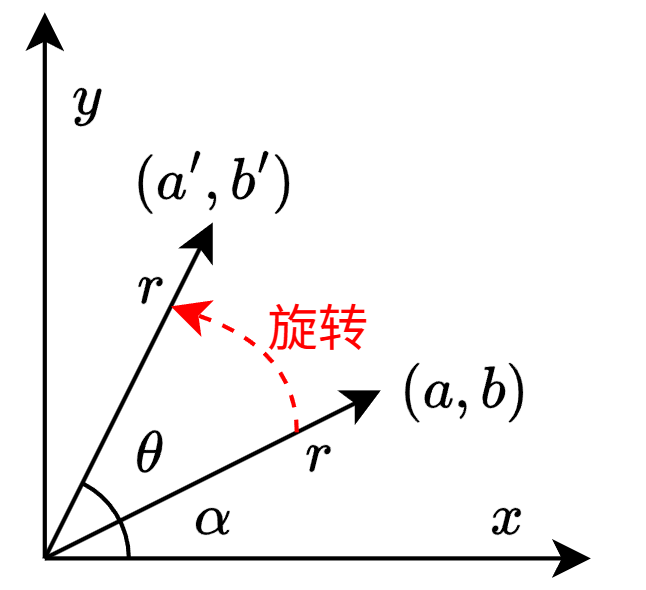
        # RoPE:在 Q 和 K 上应用旋转位置编码
        queries = apply_rope(queries, cos, sin, offset=start_pos)
        keys_new = apply_rope(keys_new, cos, sin, offset=start_pos)

        # KV Cache 管理
        if cache is not None:
            keys = torch.cat([cache[0], keys_new], dim=2)
            values = torch.cat([cache[1], values_new], dim=2)
        else:
            keys, values = keys_new, values_new
        next_cache = (keys, values)

        # 核心:将 K/V 复制到每组内的所有 Query 头
        keys = keys.repeat_interleave(self.group_size, dim=1)
        values = values.repeat_interleave(self.group_size, dim=1)

        # 注意力计算
        attn_scores = queries @ keys.transpose(2, 3)
        attn_scores = attn_scores.masked_fill(mask, -torch.inf)
        attn_weights = torch.softmax(attn_scores / self.head_dim**0.5, dim=-1)
        context = (attn_weights @ values).transpose(1, 2).reshape(b, num_tokens, self.d_out)
return self.out_proj(context), next_cache2.5 RoPE 实现
python
def compute_rope_params(head_dim, theta_base=10000, context_length=4096):
    inv_freq = 1.0 / (theta_base ** (torch.arange(0, head_dim, 2).float() / head_dim))
    positions = torch.arange(context_length)
    angles = positions.unsqueeze(1) * inv_freq.unsqueeze(0)
    angles = torch.cat([angles, angles], dim=1)  # (context_length, head_dim)
    return torch.cos(angles), torch.sin(angles)

def apply_rope(x, cos, sin, offset=0):
    # x: (batch, n_heads, seq_len, head_dim)
    x1 = x[..., :head_dim // 2]   # 前半
    x2 = x[..., head_dim // 2:]   # 后半
    cos = cos[offset:offset+seq_len].unsqueeze(0).unsqueeze(0)
    sin = sin[offset:offset+seq_len].unsqueeze(0).unsqueeze(0)
    rotated = torch.cat((-x2, x1), dim=-1)  # 旋转
return (x * cos) + (rotated * sin)2.6 SwiGLU FFN
python
class FeedForward(nn.Module):
    def __init__(self, cfg):
        self.fc1 = nn.Linear(cfg["emb_dim"], cfg["hidden_dim"], bias=False)
        self.fc2 = nn.Linear(cfg["emb_dim"], cfg["hidden_dim"], bias=False)  # 门控
        self.fc3 = nn.Linear(cfg["hidden_dim"], cfg["emb_dim"], bias=False)

    def forward(self, x):
return self.fc3(nn.functional.silu(self.fc1(x)) * self.fc2(x))三、代码文件索引
| 优先级 | 文件 | 路径 | 核心内容 |
|---|---|---|---|
| 🔥 P0 | 00_gpt2_model_structure.py | 387 行 | GPT2 完整实现:MHA + KV Cache + 生成 |
| 🔥 P0 | 01_qwen3_model_structure.py | 443 行 | Qwen3 完整实现:GQA + RoPE + SwiGLU |
| 🟡 P1 | 04_single_gpu_optimizations_pseudocode.py | 568 行 | 训练优化综合:梯度累积/ZeRO/混合精度 |